
Played, not just sold
The Dead On Darts setup guide
There’s no single “best” dart — only the one that suits your throw. Here’s how the four parts of a setup work, from people who actually throw, so you can dial in a dart that feels right.
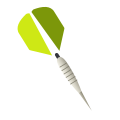
Barrels
The barrel is the dart itself — the bit you grip. Material, weight and grip are what set one dart apart from another.
- Material
- Brass is cheap and great for starting out, but it wears and is bulkier. Tungsten is the standard for serious play — it’s far denser, so a slimmer barrel hits the same weight, which means tighter grouping on the board.
- Weight
- Steel-tip darts are usually 20–26g, with most players landing around 22–24g. There’s no “correct” weight — pick what feels controlled and repeatable in your hand, not what someone else throws.
- Grip
- Smooth, ringed, knurled or shark-grip. A more aggressive grip gives more purchase but a stickier release. Match the grip to how cleanly the dart leaves your fingers.

Flights
Flights are the wings at the back. Their shape changes how much the dart is slowed and steadied in the air.
- Bigger shapes (Standard, Kite)
- More surface area means more drag and more stability — the dart sits up and lobs in. A good match for a slower, more arced throw.
- Smaller shapes (Slim, Pear)
- Less drag for a flatter, faster trajectory. They reward a clean, straight throw but are less forgiving of wobble.
- Pairing
- Flights and shafts work as a team — a bigger flight often suits a shorter shaft, a smaller flight a longer one. It’s worth experimenting.
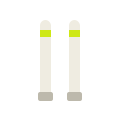
Shafts & stems
Shafts (also called stems) sit between the barrel and the flight, and they shift the dart’s balance.
- Length
- Shorter shafts bring the flight in and can tighten grouping; longer shafts move weight back and help steady a wobble. Small changes make a real difference — many players keep a couple of lengths to tune by feel.
- Material
- Nylon and plastic are cheap and easy to replace. Aluminium is sturdier and adjustable. Carbon is light, strong and barely bends.

Points
Steel points are for bristle boards; soft tips are for electronic boards. On many darts the steel point can be swapped.
- Re-pointing
- Replaceable points let you swap a bent or blunt point, or change to a grooved/knurled point that bites the wire differently for a more secure stick.
- Sharpening
- Keep steel points lightly dressed with a sharpener — you want them to grip the board, not needle-sharp, which causes bounce-outs and damages the bristle.
Ready to build your setup?
Browse the full range, or tell us how you throw and we’ll point you in the right direction.